

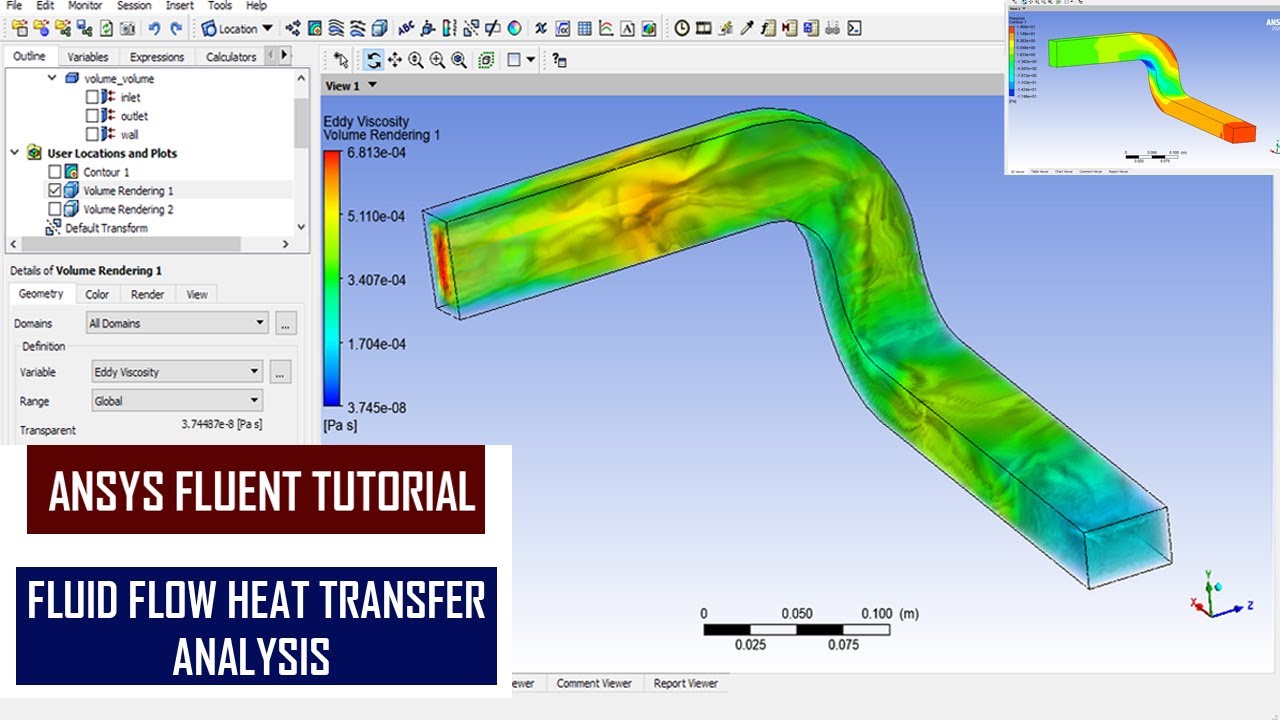
Computational Fluid Dynamics (CFD) has become an essential part of modern engineering, helping professionals analyze fluid flow, heat transfer, pressure distribution, turbulence, and many other physical phenomena. However, complex CFD projects often involve challenging geometries, advanced physics, large computational requirements, and demanding accuracy standards. Even experienced engineers can encounter difficulties when setting up, solving, or validating simulations. This is where an Ansys Fluent consulting service can provide valuable expert support.
Professional consulting can help engineering teams make better modeling decisions, avoid costly simulation errors, improve computational efficiency, and obtain results that are more useful for real-world design decisions. Instead of spending excessive time troubleshooting complicated models, organizations can work with specialists who understand both the software and the engineering principles behind CFD.
Understanding the Role of Ansys Fluent in Complex CFD Projects
Ansys Fluent is widely used for simulating fluid flow and related physical processes across industries such as aerospace, automotive, energy, manufacturing, chemical processing, and electronics. Its extensive capabilities allow engineers to model applications involving incompressible and compressible flows, turbulence, multiphase systems, combustion, conjugate heat transfer, and other advanced phenomena.
Although the software provides powerful tools, achieving reliable results requires more than simply creating a geometry, generating a mesh, and pressing the solve button. Engineers must make appropriate decisions about physical models, boundary conditions, material properties, numerical methods, convergence criteria, and post-processing.
A complex simulation can therefore become time-consuming when unexpected results occur. An Ansys Fluent consulting service can provide specialized knowledge to identify the source of problems and establish a more effective simulation strategy.
Developing the Right Simulation Strategy
One of the biggest advantages of professional CFD consulting is assistance with simulation planning. Before building a model, engineers need to determine what the simulation should accomplish and which physical effects are important.
For example, a project may require analysis of pressure losses, thermal performance, aerodynamic behavior, mixing, flow separation, or component cooling. Each objective can require different modeling assumptions and levels of detail.
Consultants can evaluate the engineering requirements and recommend an appropriate approach. This can include selecting suitable turbulence models, determining whether steady-state or transient analysis is necessary, and identifying whether additional physics should be included.
A well-planned simulation reduces unnecessary complexity while maintaining the level of accuracy needed for the engineering objective.
Improving Geometry and Mesh Quality
Mesh generation is one of the most important stages of CFD analysis. Poor mesh quality can create numerical instability, inaccurate predictions, or unnecessarily long computation times.
Complex projects may contain narrow passages, sharp edges, curved surfaces, boundary layers, moving components, or regions where strong gradients occur. These areas often require careful mesh refinement.
An experienced consultant can help engineers determine where refinement is essential and where a coarser mesh may be acceptable. This approach supports efficient use of computational resources without compromising important results.
Mesh independence studies can also help establish whether the simulation results are sufficiently insensitive to further mesh refinement. Rather than automatically creating extremely large meshes, engineers can use a systematic approach based on the physics of the problem.
Selecting Appropriate Physical Models
CFD accuracy depends heavily on selecting models that properly represent the physical behavior of the system. Choosing an inappropriate model can produce results that appear reasonable but fail to represent actual operating conditions.
For turbulent flows, for example, engineers may need to evaluate different turbulence-model options. Projects involving heat transfer may require careful treatment of thermal properties and energy equations. Multiphase applications can introduce additional complexities involving phase interactions, interfaces, and particle or droplet behavior.
An Ansys Fluent consulting service can help determine which models are appropriate for the project’s objectives and available experimental or operational data. Consultants can also explain the assumptions and limitations associated with different modeling choices.
Troubleshooting Convergence Problems
Convergence problems are common in advanced CFD projects. A simulation may experience oscillating residuals, unstable calculations, unrealistic values, or extremely slow progress.
These issues can originate from many sources, including poor mesh quality, unsuitable initialization, aggressive numerical settings, unrealistic boundary conditions, or strongly nonlinear physical behavior.
Expert guidance can help engineers systematically diagnose these problems rather than repeatedly changing settings without understanding the underlying cause. Consultants may review residual behavior, monitor important physical quantities, evaluate mesh quality, and assess solver settings to identify potential problems.
Improving convergence is not simply about forcing residuals to decrease. A successful CFD solution should also demonstrate physically meaningful and sufficiently stable engineering quantities.
Increasing Computational Efficiency
Large CFD simulations can require significant computational resources. High-resolution meshes, transient calculations, multiphase models, and complex physics can dramatically increase solution time.
Consultants can help organizations identify opportunities to make simulations more efficient. This may involve optimizing mesh size, selecting appropriate solver approaches, improving initialization methods, adjusting numerical controls, or using parallel computing effectively.
The objective is not always to create the largest possible simulation. Instead, an efficient model should provide the necessary engineering information within a practical amount of time.
Better computational efficiency can allow engineering teams to perform more design iterations, investigate additional operating conditions, and complete development projects faster.
Supporting Validation and Verification
A CFD model should not be considered reliable simply because the solver reaches convergence. Verification and validation are essential for determining whether the simulation provides trustworthy engineering information.
Verification focuses on whether the numerical model has been implemented correctly, while validation compares simulation predictions with experimental measurements, analytical solutions, benchmark cases, or reliable reference data.
An Ansys Fluent consulting service can support teams in establishing appropriate validation procedures. Consultants can help identify relevant comparison parameters, interpret differences between simulations and measurements, and determine whether discrepancies originate from modeling assumptions, experimental uncertainty, numerical limitations, or other factors.
This process helps organizations build greater confidence in CFD results before using them for important design decisions.
Handling User-Defined Models and Advanced Requirements
Some engineering projects require capabilities beyond standard CFD setups. User-defined functions, customized material behavior, specialized source terms, or unique boundary conditions may be necessary.
Developing these features correctly can be challenging, particularly when the engineering team has limited programming experience. Expert consultants can provide guidance on implementing customized approaches while maintaining a clear connection between the code and the underlying physical requirements.
This can be especially useful when standard software functionality does not completely address a project’s specific requirements.
Improving Post-Processing and Engineering Interpretation
Producing simulation data is only part of a CFD project. Engineers must interpret that information and convert it into meaningful conclusions.
A professional consultant can help teams determine which quantities should be monitored and how results should be presented. Pressure contours, velocity fields, temperature distributions, streamlines, turbulence quantities, wall shear stress, and other outputs can provide different perspectives on system behavior.
More importantly, consultants can help connect simulation results to engineering decisions. Instead of focusing only on attractive visualizations, teams can identify performance limitations, compare design alternatives, and understand why certain configurations behave differently.
Reducing Project Risks and Costs
Incorrect CFD assumptions can lead to wasted computational resources, delayed development schedules, and poor design decisions. In some cases, engineers may spend weeks troubleshooting a model that could have been improved quickly with specialized guidance.
An Ansys Fluent consulting service can reduce these risks by providing targeted expertise when internal resources are limited. External specialists can review existing models, identify weaknesses, recommend improvements, and help establish repeatable workflows.
This support can be particularly valuable for organizations that use CFD occasionally or are expanding into more advanced simulation applications.
Choosing the Right Consulting Partner
When selecting an Ansys Fluent consultant, organizations should evaluate more than software familiarity. Strong consulting support requires a combination of CFD knowledge, engineering experience, numerical understanding, and practical problem-solving ability.
A good consulting partner should be able to explain technical decisions clearly, understand project objectives, evaluate existing workflows, and provide recommendations based on engineering requirements. Experience with similar applications can also be valuable because different industries often present unique modeling challenges.
Communication is equally important. Consultants should work collaboratively with internal engineering teams so that knowledge can be transferred rather than remaining entirely external.
Conclusion
Complex CFD projects can deliver valuable engineering insights, but their success depends on appropriate modeling strategies, mesh quality, physical assumptions, numerical methods, validation, and interpretation. An Ansys Fluent consulting service can provide expert guidance throughout these areas, helping engineering teams overcome difficult simulation challenges and improve the reliability of their results.
From developing an efficient simulation strategy to troubleshooting convergence problems and validating predictions, expert assistance can save time and reduce unnecessary computational costs. Most importantly, professional guidance helps organizations use CFD as a practical engineering decision-making tool rather than simply as a software-based analysis exercise.